
|  |  |
|
| | |

© Carnegie Herald Page 1 Carnegie, Oklahoma Wednesday, September 14, 1949 1872 ~ September 13, 1949 George Kionut, well known Caddo Indian of the Prairie Lone Community, died at the Kiowa hospital in Lawton shortly after being taken there early Tuesday afternoon. He is believed to be more than. 90 years old. Services will be at the family home at 1 pm Friday and burial will be in a private cemetery on the home place, under direction of the Harvey funeral home of Fort Cobb. A resident of the community since the opening of the country, Kionute had the respect of his white neighbors as well as that of his own people. Survivors are his wife; one daughter, Mrs Beatrice Dice of Anadarko; three sons, Jake of Lookeba and Wilson and John of the home. Also 14 grandchildren abd 18 great grandchildren survive. |
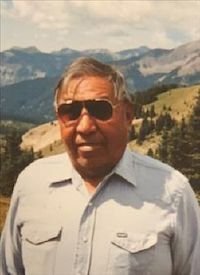
© Smith Funeral Home Anadarko, Oklahoma Wednesday July 8, 2020 April 14, 1924 ~ July 3, 2020 John Wayne Kionut was born on April 14, 1924 in Fort Cobb Oklahoma to Kionut and Edna Tabbyannauca and started his heavenly journey home on July 3, 2020 in Lawton Oklahoma. Graveside services will be held at the Kionut Family Cemetery in Fort Cobb Oklahoma on Wednesday 8, 2020 at 10 AM. Preceded by a wake at 8 PM on Tuesday 7, at First Caddo Baptist Church. Entrusted to the care of Smith's Funeral Home in Fort Cobb Oklahoma condolences and arrangements may be sent in honor of John Kionut. John was preceded in life by his brothers Anthony, Jake, Paul and Wilson and Sisters Beatrice, Mildred, Evelyn, and Mary. John was a decorated WW II Veteran where he fought in several campaigns for the United States Army in the infantry division. John was married to Mae Ravis and they had three children Merle Kionut, Ladonna Daingkau, and Edna Varela. From his three children he had 15 grandchildren Kristie Vicenti, Robert Kionut, and Paula Kionut, Wilson Daingkau, Kimberly Daingkau, George Daingkau, and Daniel Daingkau, Michelle Akerman, Maria Varela, Michael Varela, Paul Varela, Thomas Varela, Raymond Varela, Amber Varela, and Trine Varela. He was also blessed with 27 Great Grand Children and 3 Great-Great Grand Children. John left behind a legacy of laughter, love, knowledge, and true grit. He enjoyed spending time with his family and his many great grandchildren. John was also a big fan of western shows and in particular John Wayne. Throughout his life John traveled not only the world, while in the Army, but he was well traveled within the United States where he made lifelong friendships with a diverse and multicultural group of individuals. It is easy to say John's life touched countless amounts of individuals and will be missed by all. Services under the direction of Fort Cobb Funeral Home, Fort Cobb, OK. Messages of condolences may be sent to the family at www.smithfuneralserivces.com John Kionut sits in a wheelchair in what was once his father's home outside of Fort Cobb, Oklahoma. The wheelchair is a result of an injury he received in WW II. Although the injury restricts his movement, it certainly doesn't stop him. John was born in 1924 and is in his seventies. He was an active, intelligent member of his Caddo community. In his home, sitting on the head of a large drum, is a picture of his father who is reported to have lived into his 120th year. During the recording session John sings with his wife, Martha, who is a university student and photographer. Together they are very involved in the Native American Church and hold services on their land. John Kionut is the last Caddo alive to speak all four dialects of the original Caddo language. He also speaks 14 other languages fluently, although he says he is beginning to lose some of them because there is no one left to talk to. As early as 1947, John fought the US government for rights to health care. He has many times since stood publicly in Washington, DC, to preserve and protect the religious and other rights of Native Americans. When the Spanish first met the Caddo people as early as the mid 1500's, they found a highly civilized and organized nation of people that were friendly and lived well. They farmed the lands and lived in permanent cities. These cities included cone-shaped dwellings that were thatched with grass over poles. The houses sometimes stood as high as 40 feet. The homes surrounded large mounds that were temple mounds. Their society, like many others, was matrilineal, with the lineage traced through the mothers. Originally, the Caddo people occupied parts of Oklahoma and Arkansas along the Red River. The creation stories and oral traditions report that the first Caddo man and woman rose from the ground near the Red River. The man carried a pipe and the woman had seeds of corn. The name Caddo comes from the term Kado-hadacho that means "real chiefs." |